Why Aren't Your AI Leads Converting Into Booked Meetings in 2026
Why AI leads fail to convert into booked meetings in 2026. See the real data, 4 common failure points, and the hybrid fixes that actually improve show rates and pipeline.
Teams using AI for outbound or inbound lead generation often see the same outcome. Activity increases, reply rates look reasonable on the dashboard, but calendars remain surprisingly empty and the pipeline barely moves.
AI is great at producing volume. Turning that activity into meetings that actually happen—and lead to revenue, is a different challenge.
This isn't an isolated issue. Across hundreds of AI deployments throughout 2025 and 2026, the same structural problems keep appearing.
In this article, we'll look at what the latest data shows, where AI-driven lead generation typically breaks down, and what companies are doing differently to improve results.
What Do 2025–2026 Data Show About AI Lead-to-Meeting Conversion?
Recent platform benchmarks and controlled studies point to a consistent trend on AI leads converting to meetings:
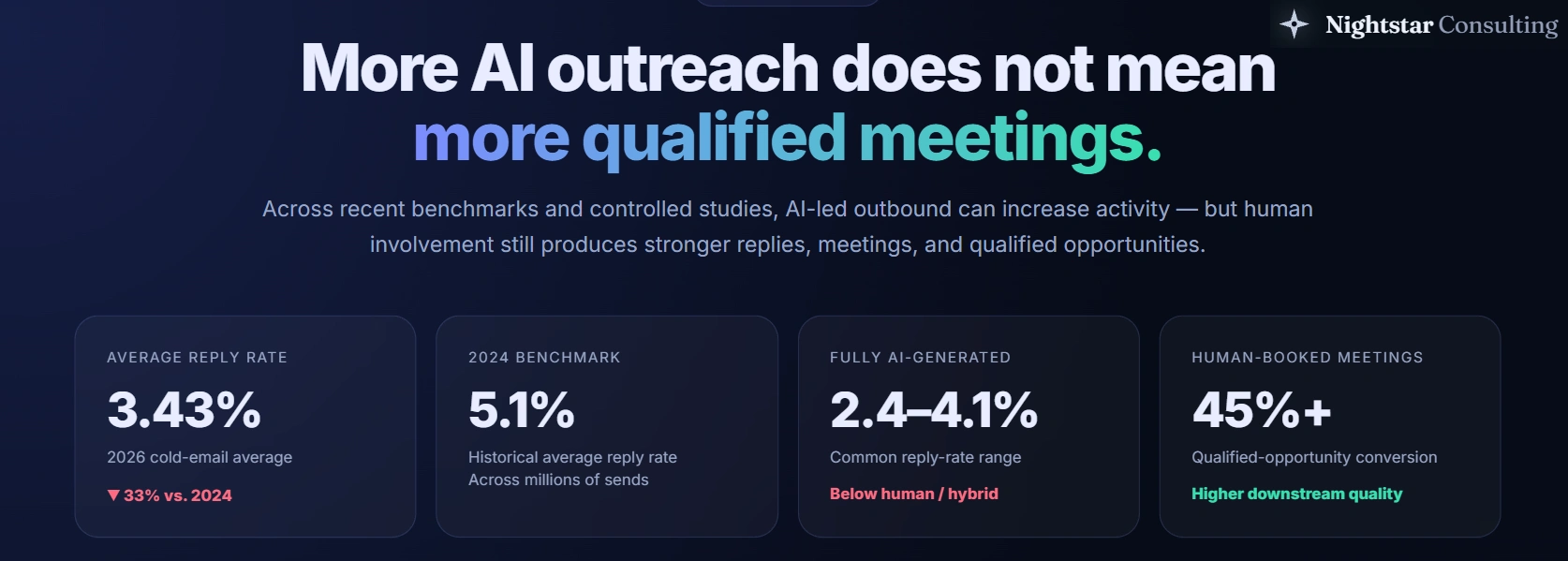
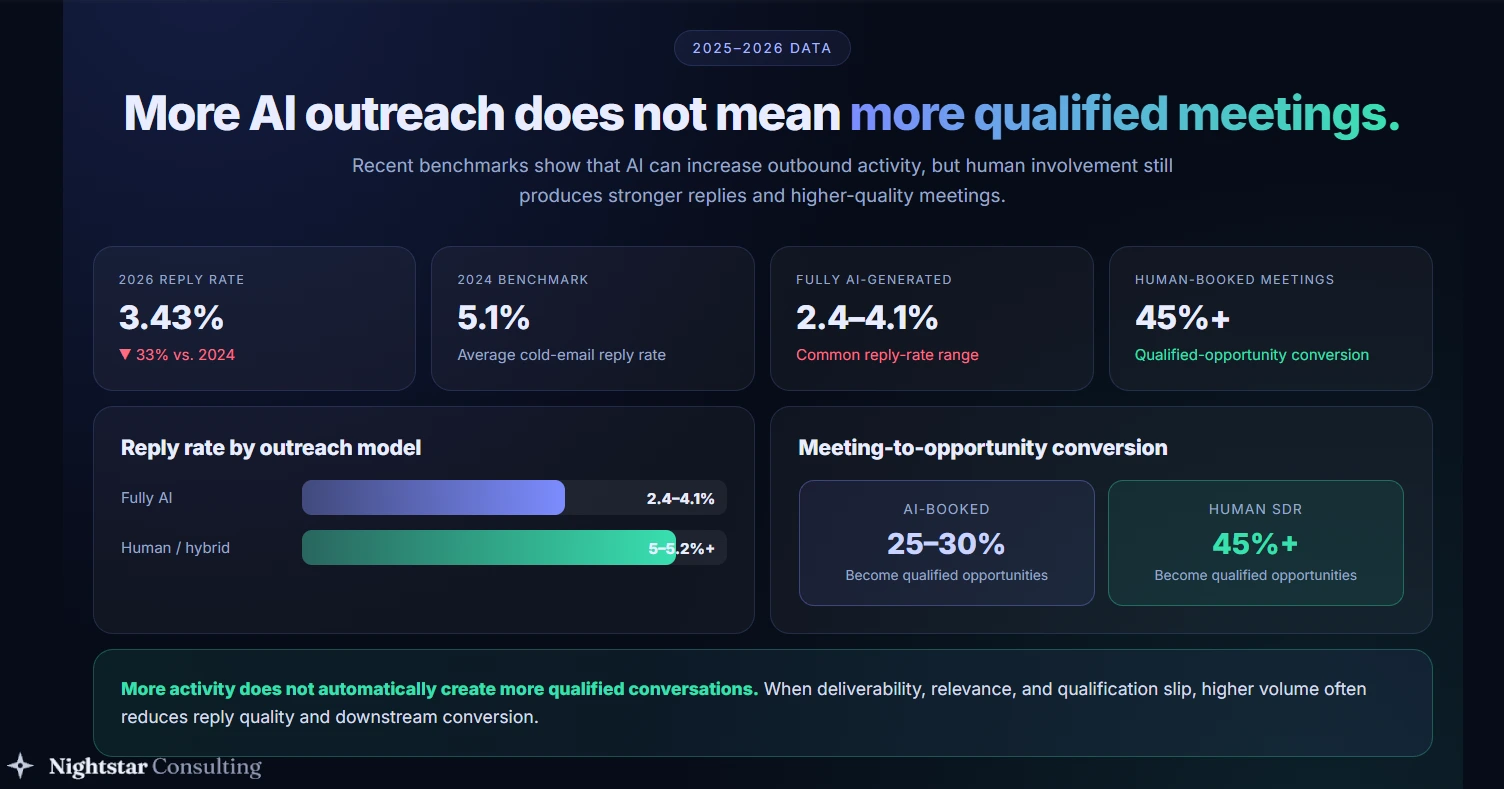
- Average cold email reply rates are around 3.43% in 2026, down from roughly 5.1% in 2024.
- Fully AI-generated outbound sequences commonly achieve reply rates between 2.4% and 4.1%.
- AI-driven outreach generally books fewer meetings than campaigns that include human involvement.
- Even when AI books meetings, those conversations become qualified opportunities far less often. Conversion rates are frequently in the 25–30% range, compared with 45% or higher for meetings booked by human SDRs.
- Many early AI SDR deployments dramatically increased outbound activity, but positive reply rates and downstream conversions still fell below the human baseline.
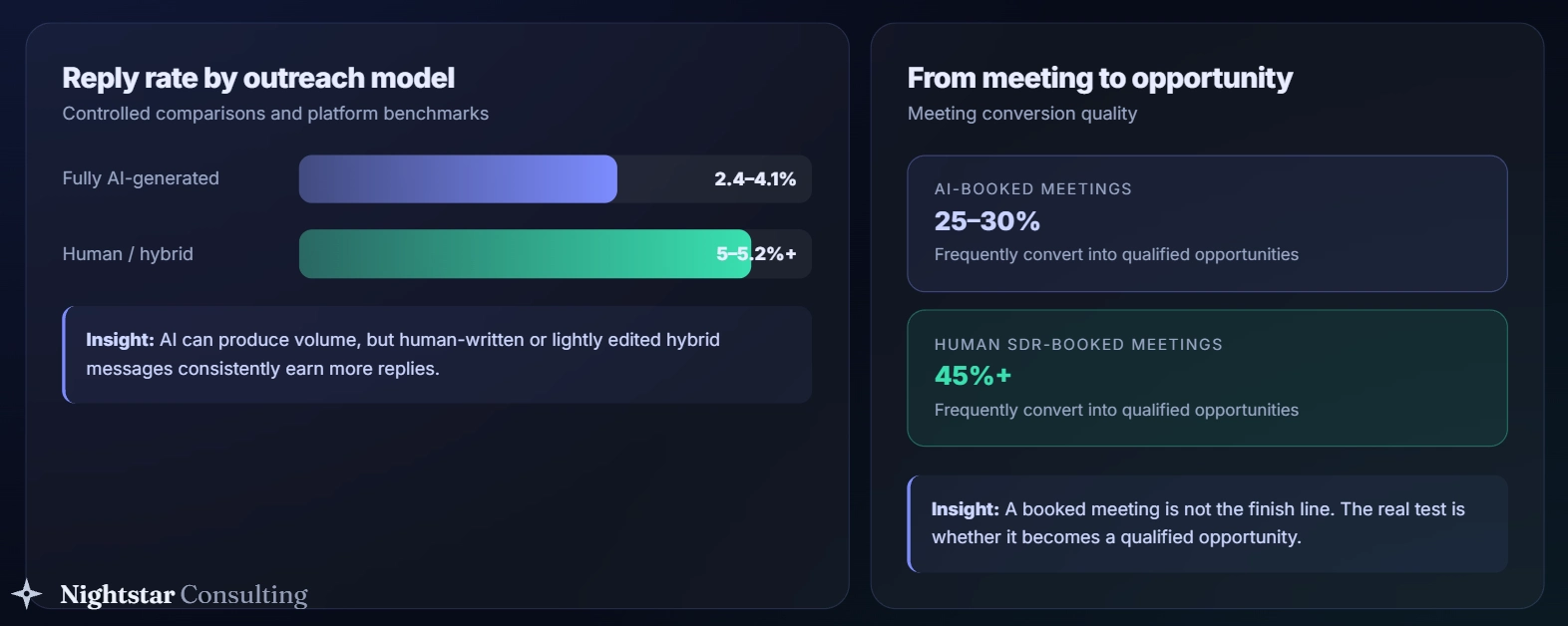
The takeaway is straightforward. More activity does not automatically produce more qualified conversations. Once deliverability, relevance, and qualification begin to slip, higher volume often creates the opposite effect.
Why Do AI Leads Struggle to Turn Into Booked Meetings?
The reason why most AI leads struggle to turn into an actuall meeting is that most AI systems are built around metrics that are easy to measure, such as emails sent, opens, replies, and calendar bookings.
What they rarely optimize for are the factors that determine whether a meeting has real value:
- Genuine buying intent at the time of outreach
- Alignment with the true Ideal Customer Profile, beyond basic firmographic filters
- The buyer's current situation and readiness to engage
- A smooth handoff to someone who can move the opportunity forward
When those pieces are missing, meetings look successful in reporting but fall apart before—or during—the first conversation.
What Are the Most Common Reasons AI Leads Fail to Book Meetings?
The same four issues show up repeatedly across real-world deployments are the most common reasons AI leads fail to book meetings.
1. No Real Buying Signal
Many AI campaigns still rely on static prospect lists instead of timely buying signals such as job changes, funding events, technology adoption, hiring activity tied to a specific problem, or visible research behavior.
Without a clear reason to contact someone now, increasing outreach simply creates more noise.
2. Weak or Missing Qualification
Many AI agents are evaluated by the number of meetings they book. As a result, almost any positive reply is treated as a success.
A prospect may agree to a meeting out of curiosity or politeness—not because they have a genuine need, budget, or decision-making authority.
3. Meetings Without Context
Prospects often join the call without a clear understanding of why they booked it.
Instead of exploring business challenges, the account executive spends the first 15 to 20 minutes explaining the value of the meeting all over again. Show rates and conversions inevitably suffer.
4. Broken or Non-Existent Handoff
Booking the meeting is only part of the process.
In many cases, the seller receives very little useful information before the call. The original buying signal, conversation history, and the prospect's stated interests are either missing or summarized so poorly that the salesperson has to start from scratch.
These problems reinforce each other. High outbound volume combined with weak signals, minimal qualification, and poor handoffs is a reliable way to fill calendars without building pipeline.
How Does Weak Qualification Kill AI Lead Conversion?
Qualification is often the hidden bottleneck of AI leads.
AI is extremely effective at identifying prospects and reaching large numbers of them. Where it still struggles is making the judgment calls that experienced salespeople make every day.
That includes deciding:
- Whether interest is genuine or simply polite
- Whether the contact controls budget and purchasing decisions
- Whether the organization is actually ready to buy
- Whether deeper research still supports the account as a strong ICP fit
When qualification is rushed or skipped altogether, low-quality meetings pile up. Sales teams spend more time chasing poor-fit opportunities, win rates decline, and confidence in the AI system starts to disappear.
Why Do Prospects Book Meetings with AI but Never Show Up?
Two factors account for most no-shows.
- Low commitment — Booking the meeting required very little effort or commitment from the prospect. Easy bookings often lead to easy cancellations.
- Lack of preparation — The prospect never developed a strong reason to protect the time on their calendar because the value of the conversation was never made clear.
Experienced SDRs naturally build commitment during a conversation. Pure AI systems rarely do.
How Can You Diagnose Whether Your AI Lead Conversion Is Broken?
If you want to know whether your AI lead conversion is broken or not, review your current process and ask a few straightforward questions.
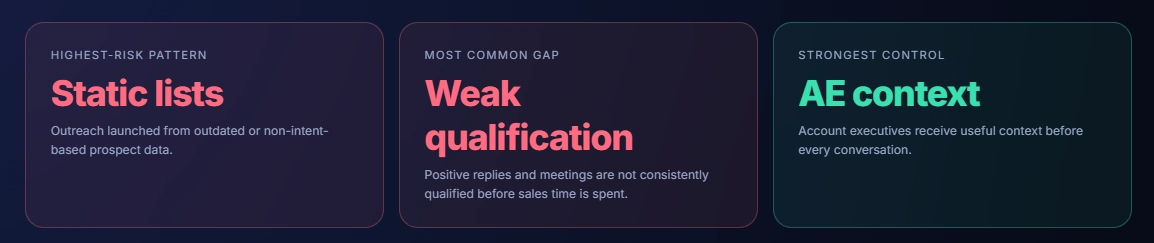
- Does every outreach sequence begin with a recent buying signal, or are you working from static lists?
- What percentage of positive replies are fully qualified before a meeting is offered?
- How does the show rate for AI-booked meetings compare with meetings booked by human SDRs?
- What percentage of AI-booked meetings become qualified opportunities?
- How much useful context does the account executive receive before the conversation?
- Has sender reputation—including spam complaints and inbox placement—improved or declined since launching AI outreach?
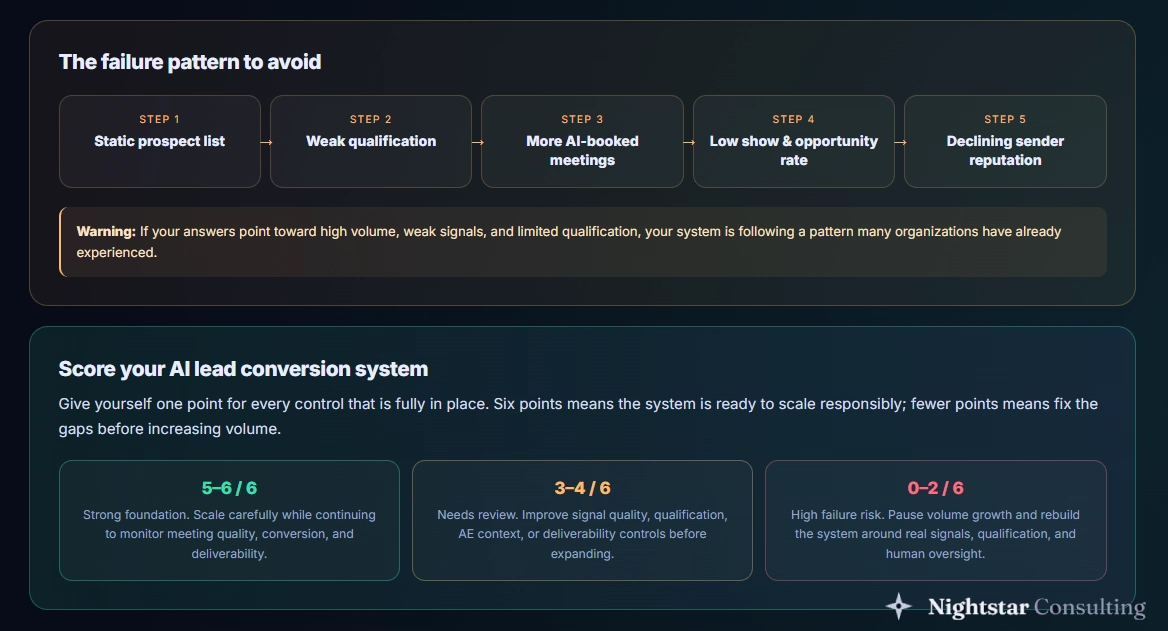
If your answers point toward high volume, weak signals, and limited qualification, your system is following a pattern many organizations have already experienced.
What Hybrid Approach Actually Improves AI Lead-to-Meeting Rates?
Companies seeing the strongest results don't replace human judgment with AI.
Instead, they use AI to speed up research, drafting, prioritization, and follow-up while keeping people involved where judgment matters most.
A typical hybrid workflow looks like this:
- AI builds prospect lists, enriches data, detects buying signals, and drafts outreach
- Humans review messaging, especially for high-value accounts or segments
- Clear stop rules prevent repeated outreach after rejections or opt-outs
- Qualification standards are applied before meetings are offered
- Complete context is passed to the salesperson before every call
- Success is measured using held, qualified meetings and pipeline created—not bookings alone
This approach preserves the efficiency of AI without sacrificing the quality needed to create real opportunities.
How Should You Measure Success Instead of Just Booked Meetings?
AI naturally maximizes whatever metric it is given.
If the goal is simply booking meetings, that's exactly what it will optimize for—even if those meetings never become revenue.
Instead, focus on metrics such as:
- Reply-to-qualified-meeting rate
- Show rate
- Meeting-to-opportunity conversion
- Opportunity-to-close rate by source (AI, hybrid, or human)
- Cost per qualified opportunity
- Pipeline generated and closed-won revenue attributed to AI-assisted outreach
When these metrics improve, your system is creating real business value. If only meeting volume increases while everything else stays flat—or gets worse—you have a volume problem rather than a pipeline problem.
Ready to Turn More AI Activity into Real Pipeline?
Nightstar helps B2B teams identify where AI-driven lead generation is breaking down and redesign the process so AI handles scale while people protect quality, qualification, and conversion.
Book a pipeline diagnostic call and we'll map your current AI lead flow, identify the biggest leaks, and show you where the highest-impact improvements can be made.
Frequently Asked Questions
Why Do AI Leads Convert at Lower Rates Than Human-Sourced Leads?
AI often prioritizes outreach volume and booking speed over careful qualification and buyer readiness. The result is more meetings with weaker fit and lower commitment.
What Is a Realistic Meeting Booking Rate for AI Outbound in 2026?
Many AI outbound programs achieve only low single-digit reply-to-meeting conversion rates. Hybrid approaches built around strong buying signals and human oversight consistently outperform fully automated campaigns.
Should We Stop Using AI for Lead Generation?
No. AI is extremely valuable for research, enrichment, prioritization, and scaling follow-up. Most failures happen when companies remove human judgment from the parts of the process where it matters most: selecting signals, qualifying prospects, and handing conversations to sales.
How Long Does It Take to Fix a Broken AI Lead System?
Most organizations can identify the largest conversion leaks within one or two weeks. Once buying signals, qualification standards, and handoff processes are improved, measurable gains in show rates and opportunity creation often appear within 30 to 45 days.
What Is the Biggest Mistake Teams Make with AI Leads?
Measuring success primarily by meetings booked instead of tracking held, qualified meetings and the pipeline those meetings actually generate.