Top Reasons Sales AI Projects Get Abandoned After 90 Days
Discover the 6 top reasons sales AI projects get abandoned after 90 days, including tracking activity instead of revenue and poor change management + how to prevent this fail.
Most sales AI projects do not fail dramatically. They simply fade.
In the first few weeks everything looks promising. Sequences go out. Dashboards light up. A few meetings get booked. Leadership feels optimistic.
Then, somewhere between day 60 and day 90, the energy disappears. Usage drops. Reps start working around the system. The budget conversation turns quiet. By the end of the quarter the project is effectively abandoned, even if no one formally cancels it.
The technology is rarely the core problem. The same failure modes appear again and again across different tools and different company sizes.
Here are the most common reasons sales AI projects get abandoned after 90 days, and what the teams that keep them alive actually do differently.
Why Do So Many Sales AI Projects Die in the First 90 Days?
This pattern is now well documented. Multiple 2025–2026 studies show that a large share of AI initiatives in sales never make it past the early experimental stage.
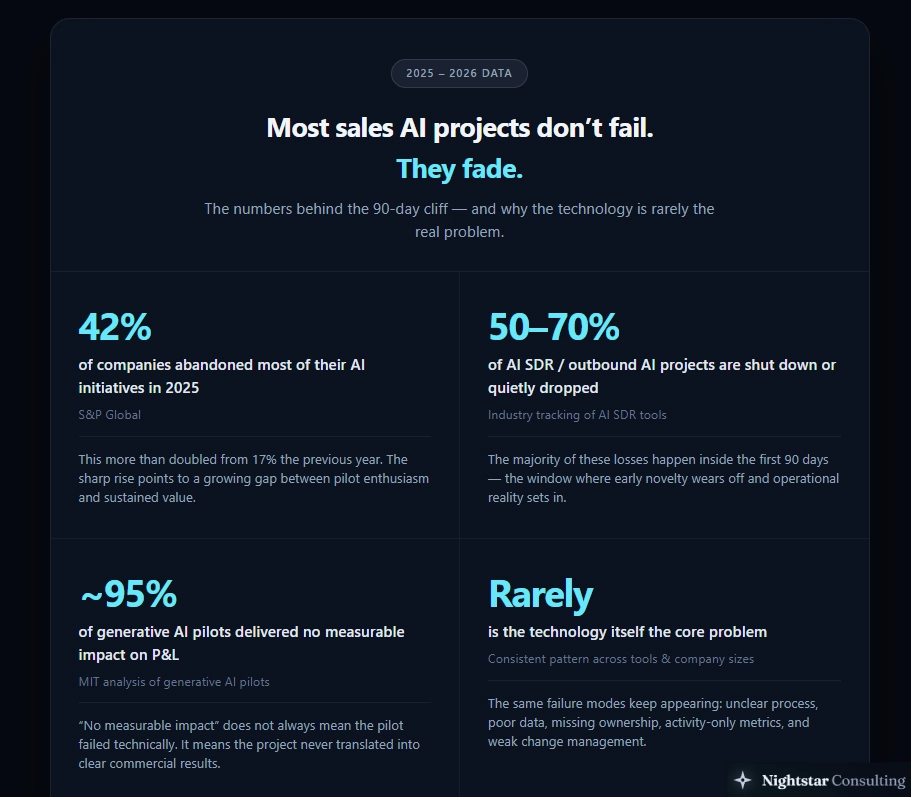
S&P Global reported that 42% of companies abandoned most of their AI initiatives in 2025 (up sharply from 17% the year before).
Research focused on AI SDR tools has found that 50–70% of those projects are shut down or quietly dropped within 90 days. MIT’s broader analysis of generative AI pilots found that roughly 95% delivered no measurable impact on profit and loss.
The 90-day mark is when early novelty wears off and real operational pressure begins. Leadership starts asking for clear ROI.
Reps decide whether the tool actually makes their lives easier or just creates more work. Data quality issues become visible. Ownership gaps surface. If these foundations were never solid, the project loses momentum fast.
What Are the Most Common Reasons Sales AI Projects Get Abandoned?
If you want to understand why so many of these projects stall, the reasons tend to show up in the same places. Here are the ones that appear most often.
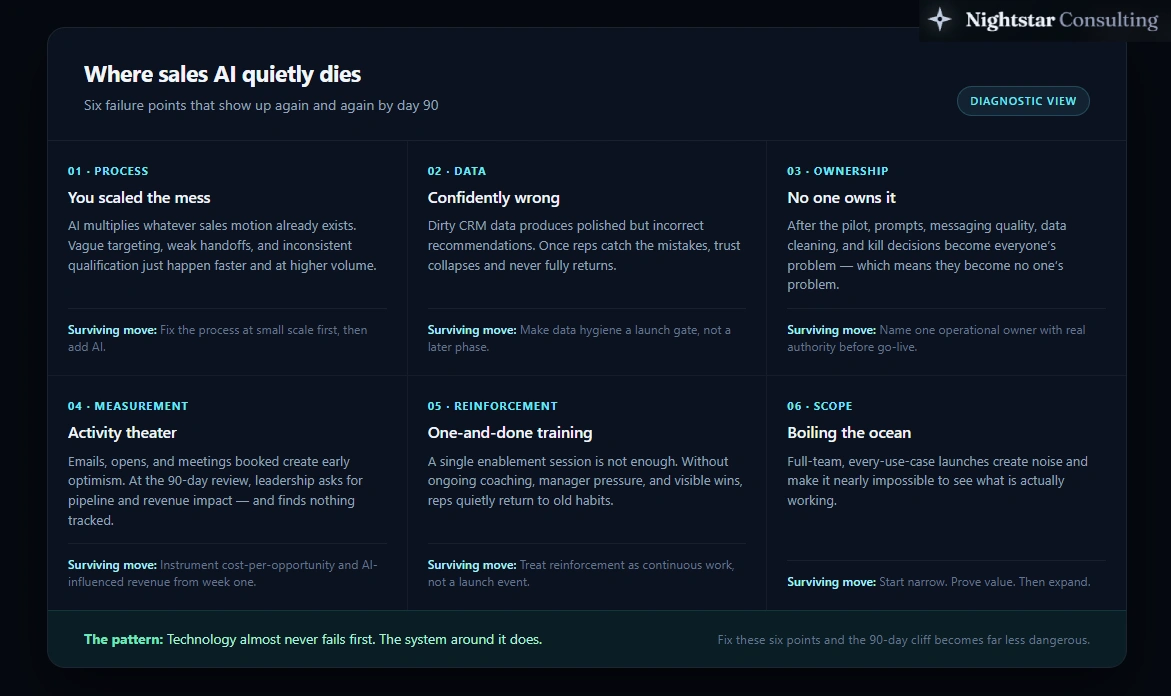
1. AI Cannot Fix a Broken Sales Process
Many teams buy AI hoping it will fix a messy sales motion. It does the opposite. AI multiplies whatever process already exists.
If targeting is vague, messaging is generic, handoffs are weak, or qualification is inconsistent, the AI simply does those things at higher volume and higher speed.
When the outputs start looking wrong or irrelevant, trust collapses. Reps stop using the system. Within a few weeks the project is already on life support.
2. Poor CRM Data Causes Sales AI to Produce Bad Results
Sales AI is only as good as the data it runs on. Incomplete CRM records, duplicate accounts, outdated contact information, and inconsistent stage definitions produce confidently wrong recommendations and messaging.
Research consistently shows that data quality and availability remain among the top reasons AI projects fail.
Once reps see the AI making obvious mistakes, they stop trusting it. Adoption never recovers.
3. Lack of Clear Ownership Causes Sales AI Adoption to Decline
Someone bought the tool. Someone ran the pilot. Then ownership became unclear. Who updates the prompts? Who reviews the messaging weekly? Who cleans the data? Who decides when a sequence should stop? Who measures real pipeline impact versus vanity metrics?
Without a clear operational owner (usually a sales ops or enablement person with real authority), the system slowly degrades. By day 90 it is still running, but no longer improving — and no longer trusted.
4. Measuring the Wrong KPIs Makes Sales AI Look More Successful Than It Is
Many projects track emails sent, opens, replies, or meetings booked. These numbers often look good in the first 30–45 days. What matters more is whether those meetings turn into qualified opportunities and closed revenue, and whether the cost per qualified opportunity actually improved.
When leadership asks for business results at the 90-day mark and the team can only show activity metrics, the project loses political support.
5. Without Ongoing Coaching, Sales AI Adoption Quickly Drop
Buying the tool and running a short training session is not enough. Sales teams are already overloaded with tools and processes. Without ongoing coaching, clear expectations, manager reinforcement, and visible wins, most reps quietly return to their old habits.
This is the same pattern seen in traditional sales methodology rollouts, where a large percentage fade within 90 days. AI projects follow the identical curve when reinforcement is weak.
6. Rolling Out Sales AI Too Broadly Too Soon Increases the Risk of Failure
Ambitious launches that try to cover the entire sales team, every sequence, and every use case at once usually struggle. The teams that succeed more often start narrow, a specific segment, a limited number of reps, one clear workflow, prove value quickly, then expand.
Wide rollouts create noise, dilute ownership, and make it harder to diagnose what is actually working.
7 Best Practices That Keep Sales AI Projects Successful After Launch
The minority of projects that survive and scale share a few practical traits:
- They start with a real, painful workflow problem rather than a desire to “use AI.”
- They clean and define the data that the AI will rely on before launching.
- They assign clear operational ownership from day one.
- They measure leading indicators that connect to pipeline and revenue, not just activity.
- They keep the initial scope tight and expand only after proof.
- They treat adoption and reinforcement as ongoing work, not a one-time training event.
- They combine AI speed with human judgment at the points that actually matter (qualification, messaging quality, and handoff).
These teams treat AI as a force multiplier for a working sales system, not as a replacement for one.
What Should You Do If Your Current Sales AI Project Is Already Losing Momentum?
Diagnose quickly. Look at usage trends, data quality issues, ownership clarity, and whether anyone can connect the activity to real pipeline. Most projects that are fading by day 60–75 can still be rescued if the root causes are addressed honestly. Waiting until the formal budget review usually makes recovery much harder.
Conclusion
In conclusion, the top reasons sales AI projects get abandoned after 90 days is because they usually fail because of process, data, ownership, measurement, and change management problems rather than because the AI technology itself is weak. The first 90 days simply reveal those gaps.
Teams that treat the first 90 days as a disciplined diagnostic and reinforcement period, rather than a passive experiment, give themselves a much higher chance of turning early activity into lasting pipeline impact.
Frequently Asked Questions
Is It Normal for AI SDR Projects to Be Abandoned So Quickly?
Yes. Multiple sources tracking AI SDR and outbound AI tools report that 50–70% of projects are discontinued or effectively abandoned within roughly 90 days.
What Percentage of AI Initiatives Get Abandoned?
S&P Global found that 42% of companies abandoned most of their AI initiatives in 2025. Broader generative AI pilot studies have shown even higher rates of projects that never deliver measurable business impact.
Can a Failing Sales AI Project Still Be Saved After 60–90 Days?
Often yes, if the team is willing to narrow the scope, fix the data and process issues, assign clear ownership, and restart measurement around real pipeline outcomes instead of activity volume.
What Is the Biggest Difference Between Projects That Survive and Those That Die?
Surviving projects treat AI as part of a redesigned sales system with clear ownership and reinforcement. Abandoned projects usually treat it as a tool that was expected to work on top of the existing motion with minimal ongoing attention.