Why AI Outbound Fails in 2026? Volume Without Judgment
Why AI outbound fails when it prioritizes volume over judgment. 2025–2026 data shows reply rates dropped to 3.43%. See the 4 failure points and how hybrid systems still win.
Most teams that implement AI outbound expect one thing: more pipeline.
What they often get instead is higher sending volume, lower reply rates, damaged sender reputation, and meetings that fail to turn into real opportunities.
The problem is not that AI cannot write emails or automate outreach. The problem is that many implementations are built around increasing volume while removing the one factor that still drives B2B conversions: judgment.
What Do 2025–2026 Data Show About AI Outbound Reply Rates?
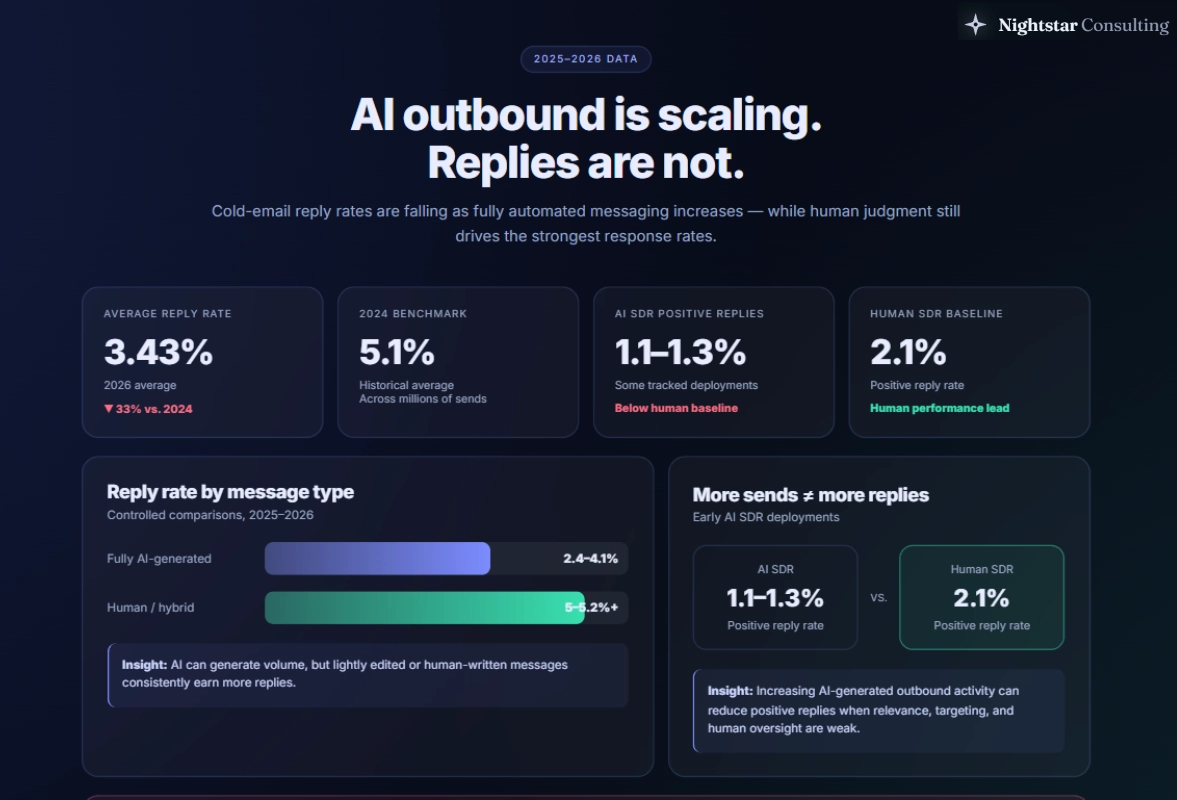
Cold email reply rates have dropped significantly. Data from platforms analyzing millions of sends shows average reply rates at roughly 3.43% in 2026, compared with around 5.1% in 2024.
When researchers compare AI-generated messages with human-written or hybrid messages, the same pattern appears repeatedly:
- Fully AI-generated cold emails often achieve reply rates between 2.4–4.1%.
- Human-written or lightly edited hybrid messages perform better, frequently reaching 5–5.2% or higher in controlled tests.
Increasing AI-generated outbound volume does not automatically improve results. In many cases, it creates the opposite effect. One analysis found that early AI SDR implementations significantly increased outbound activity while positive reply rates dropped below the human baseline, reaching around 1.1–1.3% in some tracked deployments compared with approximately 2.1% for human SDRs.
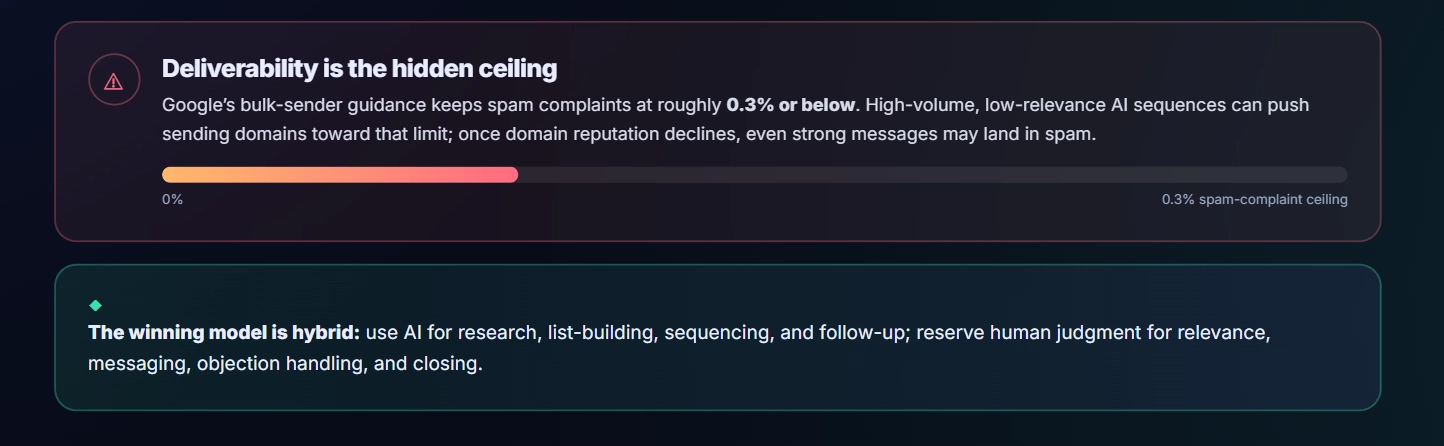
Deliverability creates another challenge. Google’s bulk-sender guidelines maintain a strict ceiling of around a 0.3% spam complaint rate. High-volume AI sequences with low relevance push many sending domains closer to that limit. Once reputation declines, even strong messages can begin landing in spam folders.
Why Does Volume Without Judgment Cause AI Outbound to Fail?
Four common failure points appear across real-world AI outbound deployments.
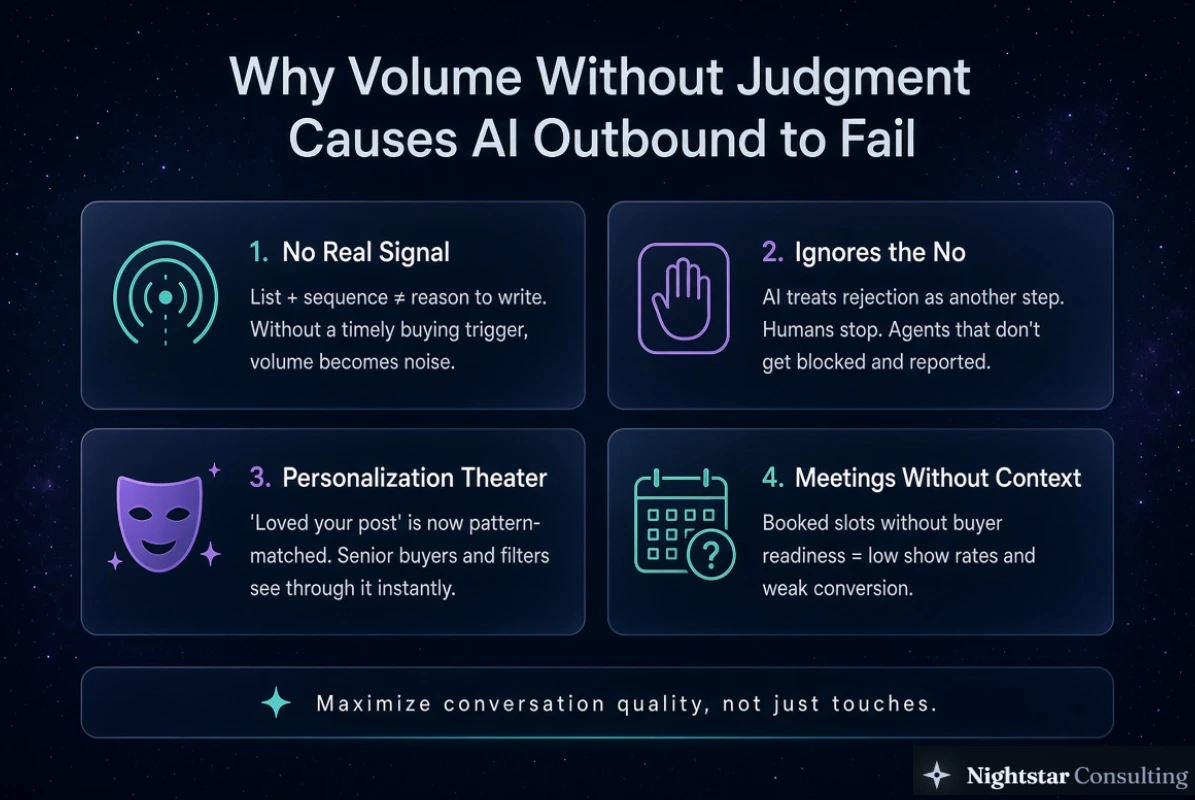
1. No Real Reason to Write
AI can generate a list and create an outreach sequence, but it does not automatically know why a specific person should be contacted at a specific moment.
Signal-based outreach, such as reaching out after a job change, funding announcement, technology change, or hiring activity related to a specific business problem, continues to outperform simple list-based campaigns.
Without a meaningful signal, higher volume only creates more noise.
2. It Does Not Stop at “No”
Experienced SDRs understand that continuing to follow up after a clear rejection usually costs more than it creates.
Many AI agents, however, treat “not interested” as just another step in the sequence. Recipients notice this behavior quickly, leading to more negative reactions, blocks, and complaints.
3. Personalization Theater
Basic AI personalization such as “Loved your recent post” or “Congratulations on the funding” has become easy for buyers and email filters to recognize.
This type of personalization rarely creates meaningful improvement and can even increase spam complaints from senior decision-makers who immediately recognize the pattern.
4. Meetings Without Context
Some AI systems are optimized to schedule meetings, but the prospect often arrives with little understanding of why they agreed to the conversation.
When the focus is only on booking calendar slots, show rates and downstream conversion suffer because the meeting was created without enough buyer readiness.
These problems are not unusual exceptions. They are the predictable result when an outbound system is designed to maximize the number of touches instead of the quality of conversations.
What Hybrid AI + Human Outbound Model Still Works in 2026?
The teams seeing consistent results in 2026 are not relying on fully autonomous AI outbound. They are using a hybrid approach:
- AI handles research, list enrichment, signal detection, and first-draft messaging at scale.
- Humans control the judgment layer: deciding who is worth contacting, whether a signal is meaningful, when outreach should stop, and how replies should be handled.
- Volume is intentionally limited. Relevance becomes the factor that protects both deliverability and brand reputation.
This model consistently performs better than either extreme. Pure human outreach is often too slow and expensive to scale, while pure AI outreach creates too much irrelevant activity and damages trust.
Multiple 2026 datasets show that AI-assisted outreach with human review and editing produces the strongest reply rates among the three approaches.
Nightstar’s positioning reflects this shift directly: AI manages the high-volume tasks involved in prospecting, routing, and follow-up. Humans remain responsible for the moments that determine whether a deal progresses, including conversations, objections, handoffs, and closing.
How Can You Diagnose If Your AI Outbound Is Failing?
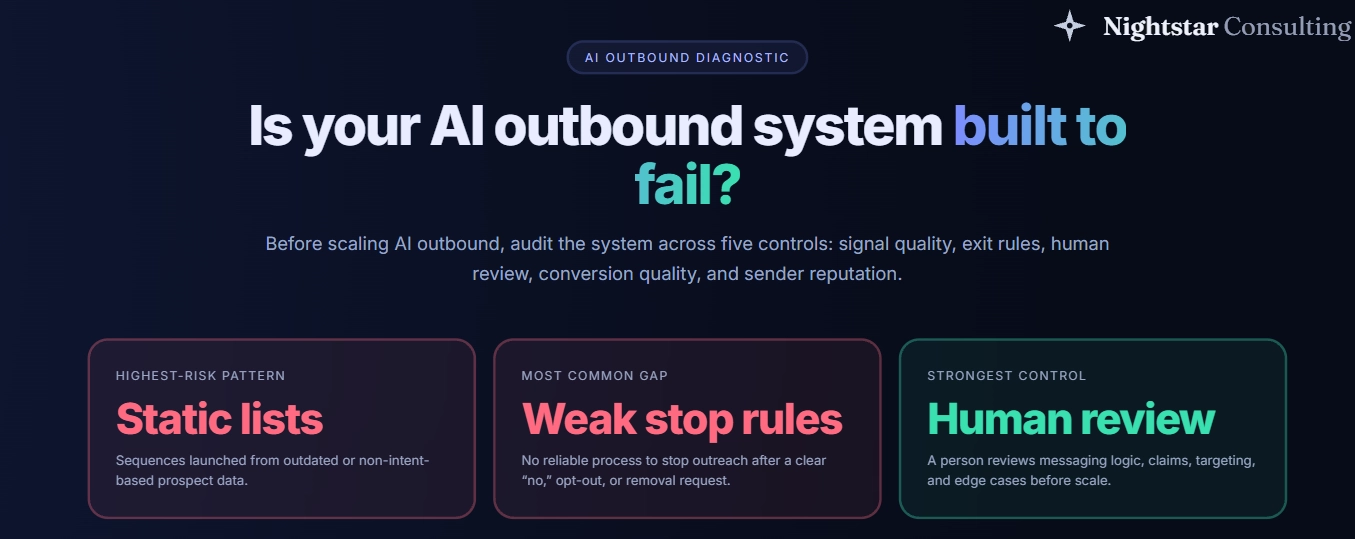
Ask these questions about any AI outbound system you are currently using or considering:
- Does every sequence begin with a real, recent buying signal, or does it start from a static list?
- Is there a clear stop rule when someone says no or requests removal?
- Who reviews the actual messages before they are sent at scale?
- What percentage of booked meetings become qualified opportunities?
- Has sender reputation, including spam complaint rates and inbox placement, improved or declined since launch?
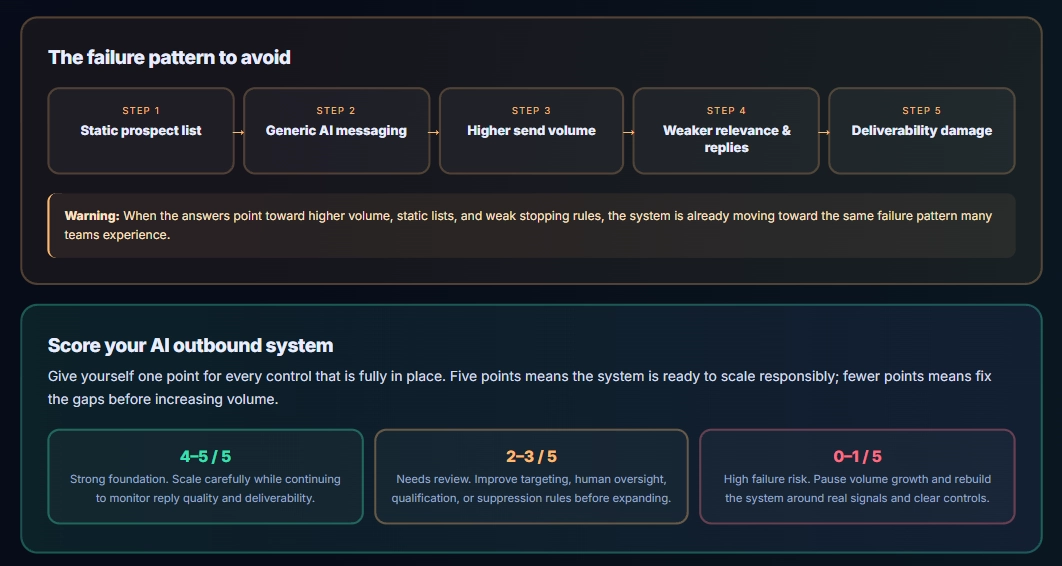
If the answers point toward higher volume, static lists, and weak stopping rules, the system is already moving toward the same failure pattern many teams experience.
What Should Teams Do Instead of Pure AI Outbound Volume?
- Use AI as a research and drafting tool, not as a fully autonomous sender.
- Require a clear reason for outreach before launching any sequence.
- Limit daily sending volume per domain and track spam complaint rates every week.
- Keep humans involved in replies, escalation decisions, and stopping outreach when needed.
- Measure qualified pipeline and closed revenue, not only emails sent or meetings booked.
Volume is easy to create. Good judgment is much harder to scale.
The teams that succeed in 2026 and beyond will be the ones that use both without sacrificing one for the other.
Want to see where your current outbound is losing relevance and hurting deliverability?
Nightstar identifies the gaps between AI-driven volume and human judgment, then builds the hybrid system needed to maintain both scale and conversion.
Frequently Asked Questions
How Can Teams Use AI Outbound Without Destroying Results?
Use a hybrid model:
AI handles signal detection, enrichment, and drafting. Humans handle list prioritization, stop rules, reply management, and quality control.
Keep volume controlled and measure qualified pipeline, not just the number of messages sent.
What Is the Biggest Risk of High-Volume AI Outbound?
Deliverability damage.
When spam complaint rates approach Google’s 0.3% threshold, even strong future messages can struggle to reach inboxes. Recovering a damaged sending domain can be costly and time-consuming.
Should Teams Replace SDRs With AI Agents?
Most high-performing teams in 2026 do not. Instead, they use AI to reduce the time spent on research and drafting so SDRs can focus on judgment, conversations, and higher-value accounts.
Replacing human decision-making with more volume is the approach that fails most often.
Does AI Personalization Still Work in Cold Email?
Surface-level AI personalization, such as adding a name, company detail, or generic compliment, has largely lost its effectiveness. Signal-based personalization supported by real research continues to perform better, especially when a human reviews or edits the final message.
Fully automated “personalization theater” often performs worse than simple, well-written outreach.
Why Do AI Outbound Reply Rates Keep Falling?
Because inboxes are increasingly crowded with low-relevance, AI-generated messages. Buyers and spam filters have adapted. Across large datasets, average cold email reply rates declined from roughly 5.1% in 2024 to around 3.43% in 2026.