How to Identify Hidden Leaks in Your B2B Sales Pipeline
Discover the 11 most common B2B sales pipeline leaks that quietly kill revenue. Learn how to run a full pipeline leak audit in one week and fix the highest-impact gaps first.

How to Identify Hidden Leaks in Your B2B Sales Pipeline?
Most pipelines don’t collapse in one dramatic moment. They leak.
- A lead sits untouched for 18 hours.
- A handoff has no clear owner.
- A deal ages past its normal stage time with no real next step.
- Cadences stop after three touches.
- Routing rules send the best accounts to the wrong reps.
Individually, these issues may seem minor, but combined, they quietly erode 10–20% of potential revenue each year. Recent industry audits by Gartner and other analyst firms place average operational revenue loss squarely in this range. Rather than showing up in lost-deal reports, this revenue slips through the cracks between systems, teams, and daily execution.
Designed for sales leaders, RevOps professionals, and founders who generate healthy pipeline volume yet consistently fall short of target revenue, this field guide outlines our proven diagnostic framework for evaluating revenue organizations.
What Counts as a Real Sales Pipeline Leak?
A true pipeline leak is not simply a lost deal. It happens when a viable opportunity is lost because of avoidable issues in the sales process, rather than because a prospect chose a competitor after a proper evaluation or because the deal moved forward according to a planned timeline.
Pipeline leaks usually happen when:
- A promised action or commitment is not followed through
- Ownership and accountability are unclear
- A critical follow-up step is missed
- Operational issues or data gaps prevent a qualified opportunity from moving forward
Relying only on CRM stage conversion metrics often hides these problems because CRMs track the actions that are recorded, not the important actions that were missed.
What Are the 11 Most Common Sales Pipeline Leaks in B2B?
The following are the sales pipeline leaks we see most often across B2B organizations, including SaaS, professional services, industrial, and financial services companies. They are ranked roughly by how frequently they occur and the impact they have on revenue.
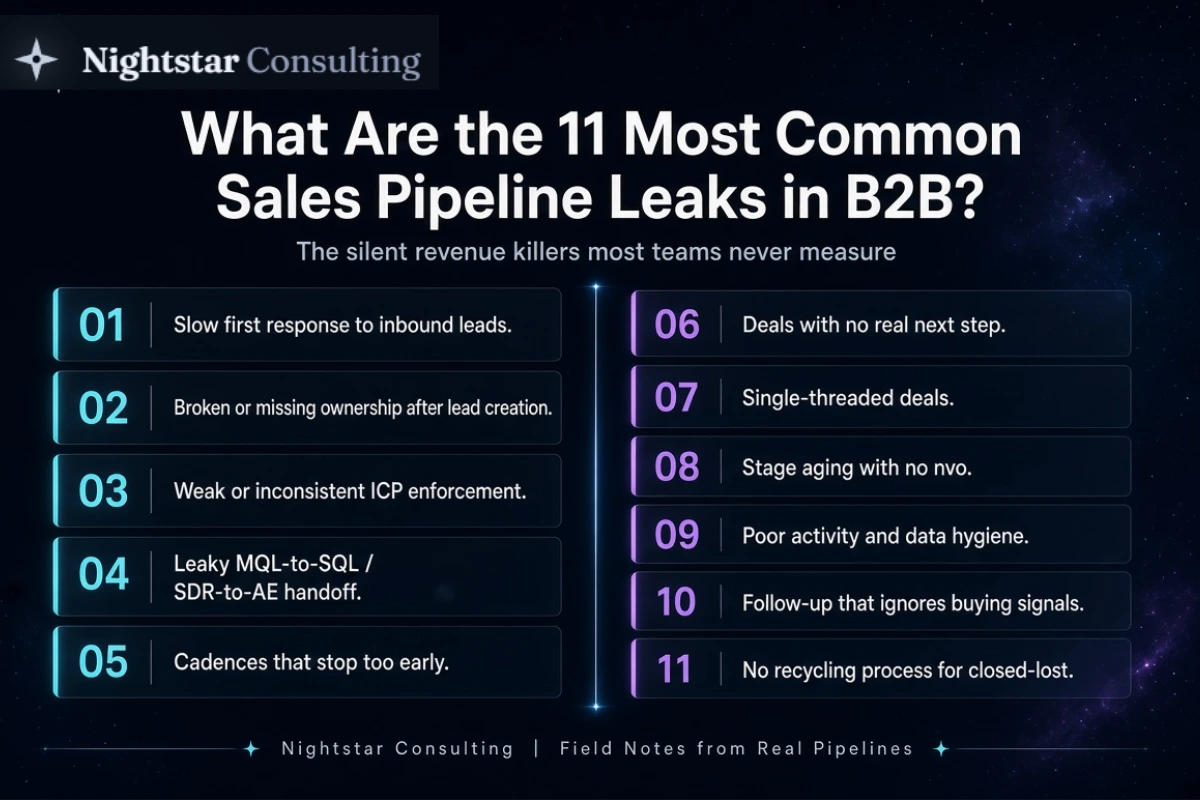
1. Slow First Response to Inbound Leads
For many sales teams, the median time between lead creation and the first human interaction is still measured in hours. Research consistently shows that responding within minutes dramatically increases the chances of qualifying a lead. Once response time extends beyond an hour, conversion rates begin to decline significantly.
2. Broken or Missing Ownership After Lead Creation
Many leads enter the pipeline without a clear owner, or they are assigned to someone who is out of office with no backup in place. Round-robin assignment systems without proper fallback rules are one of the most overlooked causes of pipeline leakage.
3. Weak or Inconsistent ICP Enforcement
Pipelines often become filled with companies that look impressive but fall outside the organization's true Ideal Customer Profile (ICP). These opportunities consume valuable sales time, inflate pipeline coverage metrics, and rarely convert into closed deals.
4. Leaky MQL-to-SQL or SDR-to-AE Handoff
Marketing and sales teams frequently use different definitions of what qualifies as a sales-ready lead. Notes are incomplete, important context gets lost, and prospects are forced to repeat information they've already shared. As a result, momentum disappears.
5. Cadences That Stop Too Early
Many outreach sequences end after only three or four touchpoints. As a result, high-intent prospects who require seven to nine touches before engaging never receive the follow-up they need.
6. Deals With No Real Next Step
"Follow up next week" is not a meaningful next step. A legitimate next step is a specific, dated action that has been confirmed by the buyer. Without that commitment, deals tend to stall.
7. Single-Threaded Deals
Many opportunities rely on a single contact, with no relationship established with the economic buyer or the broader buying committee. If that contact becomes unresponsive or leaves the company, the deal usually disappears with them.
8. Stage Aging With No Escalation
Deals often remain in the same pipeline stage well beyond the normal timeframe without manager intervention or a structured review process. When this happens, hope replaces process, and opportunities continue to linger without progress.
9. Poor Activity and Data Hygiene
Missing activity logs, outdated close dates, duplicate records, and incomplete CRM fields make forecasting and prioritization unreliable. AI tools built on poor-quality data don't solve the problem, they simply accelerate the wrong decisions.
10. Follow-Up That Ignores Buying Signals
Instead of prioritizing outreach based on actual engagement, buying intent, or customer fit, many sales teams treat every lead the same. As a result, high-potential accounts receive the same follow-up cadence as low-quality prospects.
11. No Recycling Process for Closed-Lost or "Not Now" Opportunities
Strong-fit accounts that respond with "not this quarter" are often forgotten instead of being placed into a structured re-engagement program. Without a recycling process, valuable future opportunities are lost.
These eleven issues account for the majority of operational pipeline leakage we uncover. In most organizations, three to six of these leaks are occurring simultaneously.
You don't need a six-week consulting engagement to uncover the biggest gaps in your sales pipeline. What you need is honest data and a focused set of questions.
How to Run a Sales Pipeline Leak Audit in One Week
You don't need a six-week consulting engagement to uncover the biggest gaps in your sales pipeline. What you need is honest data and a focused set of questions.
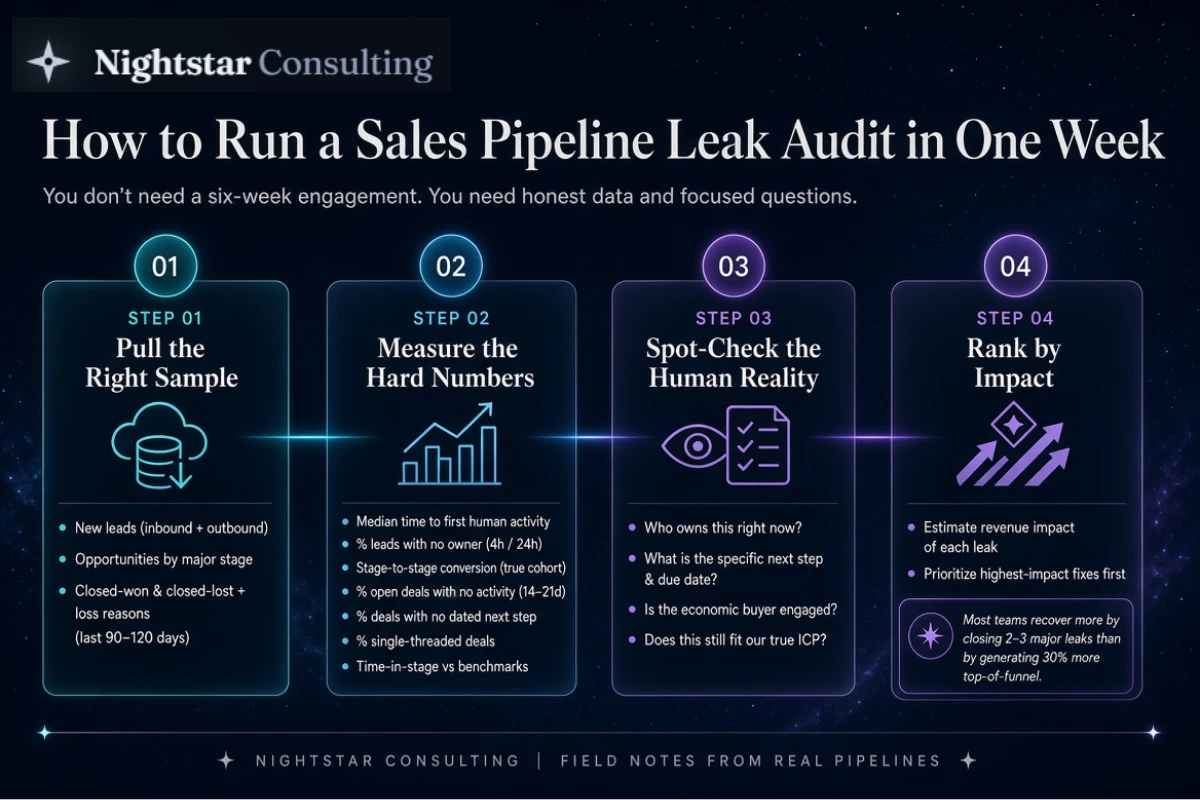
Step 1 – Pull the Right Sample
Export data from the last 90–120 days, including:
- New leads (inbound and outbound)
- Opportunities that entered each major pipeline stage
- Closed-won and closed-lost opportunities, along with their recorded loss reasons
Step 2 – Measure the Hard Numbers
For your sample, calculate the following metrics:
- Median time from lead creation to the first human activity (broken down by lead source)
- Percentage of leads with no assigned owner after 4 hours and after 24 hours
- Stage-to-stage conversion rates (using a true cohort rather than calendar-month snapshots)
- Percentage of open opportunities with no recorded activity in the past 14–21 days
- Percentage of open opportunities with no dated next step
- Percentage of deals that are single-threaded
- Average and median time spent in each stage compared with your historical benchmarks
Step 3 – Spot-Check the Human Reality
Review 20–30 recent records and ask the following questions:
- Who owns this opportunity right now?
- What is the specific next step, and when is it due?
- Is the economic buyer engaged?
- Does this account still fit our true Ideal Customer Profile (ICP)?
Step 4 – Rank by Impact
Estimate the potential revenue impact of each leak and prioritize fixes based on their impact. Focus on addressing the highest-impact issues first.
Most teams recover more revenue by closing two or three major pipeline leaks than by generating 30% more top-of-funnel activity.
How Do High-Performing Teams Prevent Sales Pipeline Leaks?
High-performing teams treat pipeline leakage as a system problem, not a motivation problem.
They create clear entry and exit criteria for every pipeline stage based on buyer actions rather than internal tasks. They enforce ownership rules with reliable backup processes, review stalled opportunities every week using evidence instead of opinions, and measure actual behavior change and outcomes rather than simply tracking tool adoption.
They also combine AI-driven speed, including routing, prioritization, follow-up reminders, and data enrichment, with human judgment at the moments that truly influence deal outcomes.
AI alone only fills the system with more of the same problems at a faster pace. Human judgment alone cannot handle the scale and volume required. The teams that succeed in 2026 will use machines for high-volume tasks while keeping people focused on high-judgment decisions.
Ready to find the leaks in your pipeline? Nightstar helps revenue teams diagnose the exact gaps slowing down their sales process and install the systems that keep deals moving.
Book a Pipeline Diagnostic Call →
How to Start Fixing Sales Pipeline Leaks Today
If your pipeline looks healthy on paper but your quarter continues to fall short, the issue is rarely that you simply need more leads. In most cases, one or more of the pipeline leaks discussed above is holding back revenue.
The fastest way to improve performance is through a focused diagnostic: map the actual sales flow, quantify the biggest gaps, and prioritize the fixes that directly impact closed-won revenue.
That is the work we do at Nightstar. We identify pipeline leaks, build AI-supported systems to address them, and equip teams with the processes needed to make those improvements last.
If you want a clear, prioritized view of where your pipeline is losing revenue today, tell us where your deals are stalling. We’ll come back with the map.
Frequently Asked Questions
Here are some of the frequently asked questions on this topic:
What Are The Most Common Sales Pipeline Leaks In B2B?
The most common leaks include slow first response, missing ownership, weak ICP enforcement, broken handoffs, cadences that stop too early, deals with no next step, single-threaded deals, stage aging without escalation, poor data hygiene, ignored buying signals, and no closed-lost recycling process.
How Do I Identify Hidden Revenue Leaks In My Sales Pipeline?پ
Export the last 90–120 days of data, calculate response time, ownership gaps, stage conversion, activity rates and single-threading, then manually review 20–30 recent opportunities for ownership, next steps, and ICP fit.
Should I Fix Pipeline Leaks Before Generating More Leads?
Yes. Adding more leads into a leaking pipeline increases waste. Closing the biggest leaks first improves conversion of existing demand and delivers faster, more efficient revenue growth.
How Long Does It Take To Run A Proper Pipeline Leak Audit?
A focused audit can be completed in one week using existing CRM data and a structured review of recent opportunities.
How Can I Prioritize Which Pipeline Leaks To Fix First?
Estimate the potential revenue impact of each leak and focus first on the highest-impact issues — usually ownership gaps, slow response, and missing next steps.