Why Sales Representatives Fear AI Replacing Their Jobs
Learn how to overcome sales team pushback on CRM AI tools. Practical steps to reduce resistance, improve adoption, and help reps see real value from AI.
The fear is widespread and, in many ways, rational. When vendors lead with messages about “replacing SDRs” or “running outbound without headcount,” and when leadership starts asking how much of the team can be automated, salespeople pay attention.
They have seen previous technology waves over-promise and under-deliver. This time the stakes feel higher.
Yet the data and the reality of complex B2B sales point in a different direction than the loudest headlines.
Why Do Sales Representatives Fear AI?
Sales roles have absorbed wave after wave of new tools, CRMs, engagement platforms, conversation intelligence, that often increased administrative burden while delivering uneven results.
Many representatives learned to treat bold technology claims with skepticism. AI intensifies that skepticism for five practical reasons:
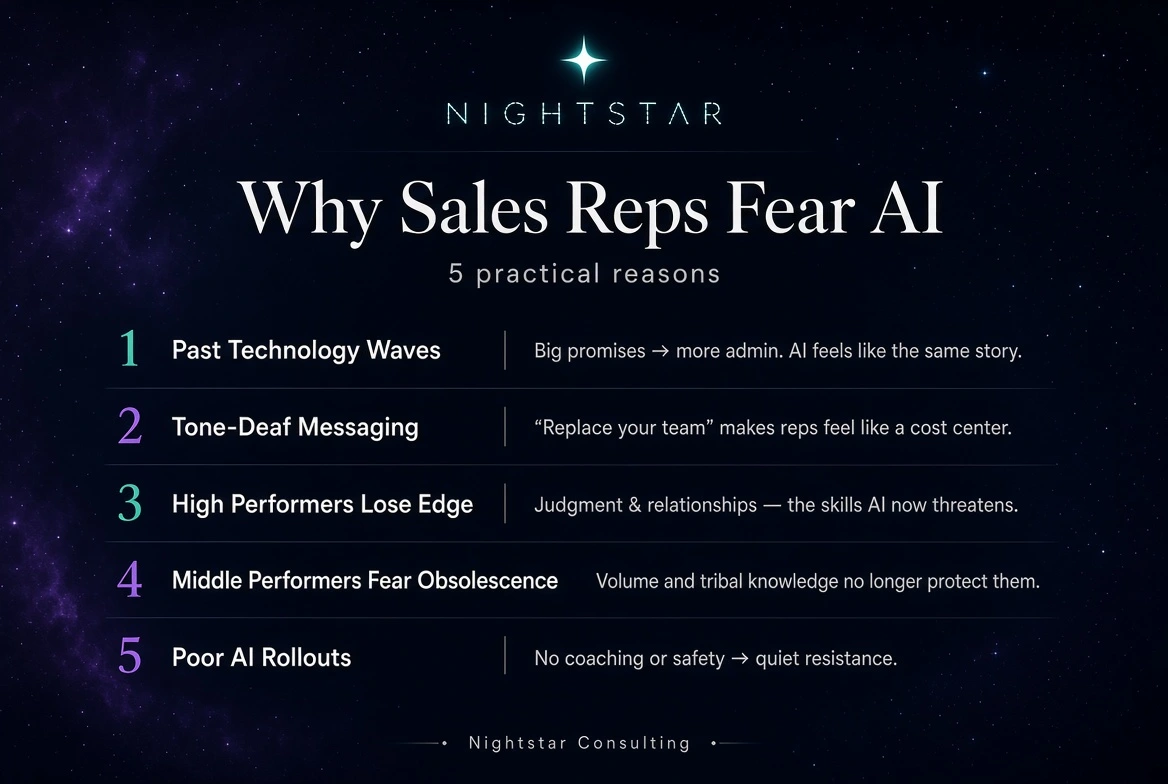
1. Past Technology Waves Trained Them to Be Skeptical
CRM implementations, sales engagement platforms, and conversation intelligence tools were often sold with big promises. Many reps experienced the opposite: more admin work, rigid processes, and tools that didn’t understand the nuance of a real conversation.
From firsthand experience as a sales leader, a poorly designed rollout can completely undermine good technology. One company rolled out a pipeline tool designed to automatically email candidates when new jobs opened.
In theory it sounded efficient. In practice, it ignored the delicate relationships reps had built. Candidates received too many emails, opt-out requests skyrocketed, and years of relationship equity were damaged.
A simple ability to segment pipelines and set clear email limits would have given the tool a real chance to succeed. AI often feels like a larger version of the same story.
2. The Messaging From Vendors Is Often Tone-Deaf
Too many AI sales tools lead with “replace your SDR team” or “10x output with zero headcount.” Even when the product is assistive, the marketing creates an adversarial frame. Reps hear: “You’re the cost center we’re optimizing away.”
3. High Performers Worry About Losing Their Edge
Top AEs and SDRs built careers on judgment, relationship skills, timing, and reading the room. When AI can generate personalized emails at scale or prioritize accounts instantly, it threatens the very skills that made them valuable.
4. Middle Performers Fear Becoming Obsolete Faster
Reps who relied on volume, persistence, or tribal knowledge see AI closing the gap quickly. The fear isn’t abstract, it’s personal career risk.
5. Managers Often Introduce AI Poorly
This issue is often worse for managers. Many front-line leaders only get trained a short time before their teams, so they don’t have enough time to really learn the tool. Then they’re expected to answer questions and fix problems as if they’re already experts.
This creates frustration and makes it harder for them to lead the change. At Nightstar, we make sure managers are comfortable with the technology well before it rolls out to everyone else, so they can support their teams with confidence.
AI Sales Adoption Statistics: What the Data Reveals About Job Replacement
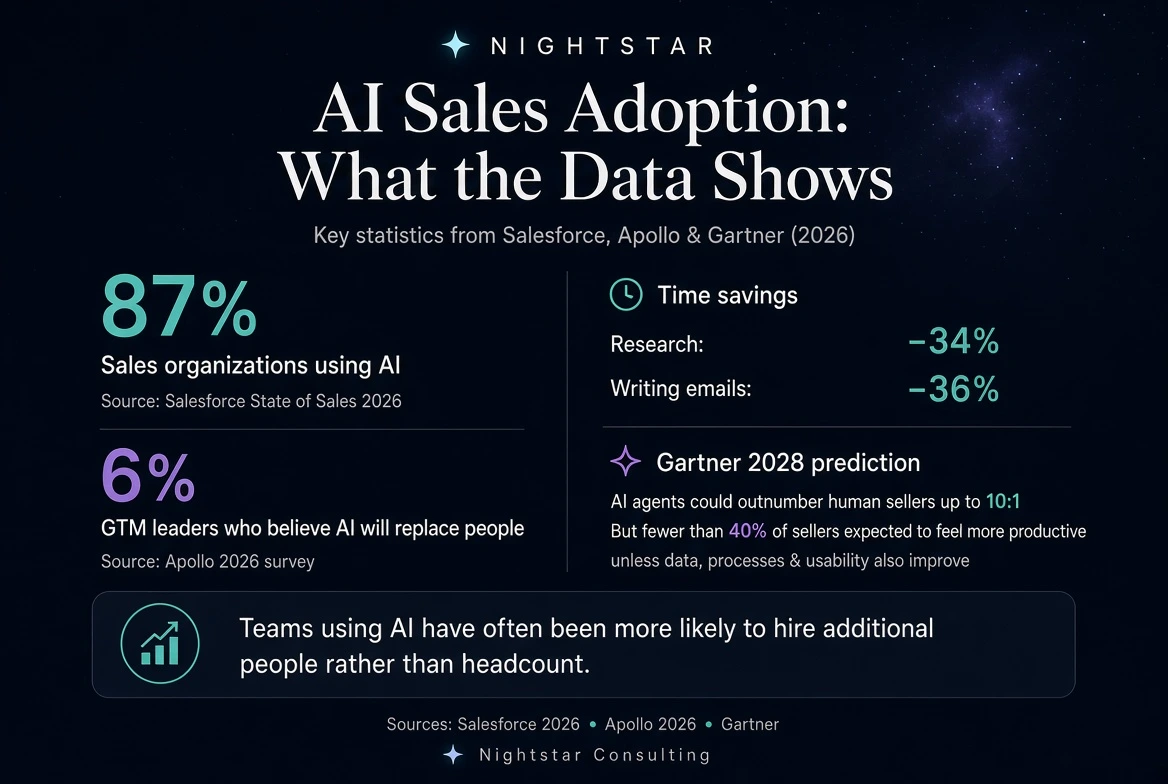
Adoption of AI in sales is already high. According to Salesforce’s 2026 State of Sales report, 87% of sales organizations now use some form of AI. Common uses include finding leads, forecasting, scoring opportunities, and writing outreach messages.
AI agents are also expected to save time. Research shows they can cut the time spent researching prospects by about 34% and the time spent writing emails by about 36%.
At the same time, a 2026 survey by Apollo found that only 6% of go-to-market leaders believe AI will eventually replace people on their teams. Most leaders see AI as a way to support their teams, not replace them.
Gartner predicts that by 2028, AI agents could outnumber human sellers by as much as 10 to 1. However, the same research says that fewer than 40% of sellers will feel these agents actually made them more productive, unless companies also improve their data, processes, and how easy the tools are to use. Simply adding more AI agents does not automatically lead to better results.
Interestingly, teams that use AI have often been more likely to hire additional people rather than reduce headcount. In many cases, technology is helping teams do more, not less.
Why Complex Sales Still Require Human Sales Representatives
In complex, high-value sales, some things are still hard for AI to handle well:
- Trust when the stakes are high. When a buyer is spending a lot of money or putting their reputation on the line, they usually want a real person who will take responsibility if something goes wrong.
- Managing many decision-makers. Big deals often involve several people with different goals and concerns. Getting everyone aligned still needs human skill and emotional awareness.
- Understanding what’s not being said. Tone of voice, hesitation, and hidden worries still influence deals. AI often misses these subtle signals.
- Buyer preference. For important purchases, many senior buyers still prefer talking to a person rather than dealing only with automated systems.
AI is strong at tasks that need speed and volume, like research, ranking leads, writing first drafts of emails, cleaning data, and sending routine follow-ups. But it is much weaker at the critical moments that usually decide complex deals.
Many sales teams are already experimenting with AI, but few have figured out how to introduce it without creating fear or resistance. At Nightstar, we help revenue leaders design hybrid systems that combine AI speed with human judgment, so tools get adopted and results show up in the pipeline.
Want help diagnosing where AI is creating friction (or opportunity) in your sales process?
The Bigger Career Risk for Sales Reps Who Resist AI Tools
The bigger risk for salespeople is not that AI will suddenly take their job. The real risk is slowly becoming less relevant.
Reps who treat AI as the enemy and refuse to use it often fall behind colleagues who learn how to work with the tools. Those who use AI to handle boring, low-value tasks free up time for important conversations and usually become more productive and more valuable to their company.
There’s also a practical warning about outbound. When teams send too many low-quality AI-generated messages, they can damage their email domain and make buyers less willing to respond. High volume without good judgment often creates the exact problems many salespeople are afraid of.
How Sales Leaders Can Reduce AI Adoption Fear in Their Teams
Teams that handle AI well usually do a few simple things:
- They present AI as a way to remove boring work, not as a way to remove people.
- They involve strong salespeople early when choosing tools and designing new processes.
- They combine every new AI tool with clear coaching and expectations.
- They measure success by better pipeline quality, higher conversion rates, and more time spent selling, not just by how many emails or calls were made.
When leaders do these things, resistance usually drops and more people start using the tools.
Beyond the Fear: How AI Is Actually Changing Sales Roles
The data tells a more nuanced story than the hype:
- Most organizations that successfully scale AI in sales treat it as a force multiplier, not a replacement.
- Hybrid models (AI handling research, prioritization, and first-touch volume + humans owning judgment, complex conversations, and closing) consistently outperform pure AI or pure human approaches.
- The biggest drop-off in AI sales projects still happens in the first 90 days — usually because of poor change management, not because the technology failed.
Salespeople who understand this distinction stop fighting the tools and start directing them.
Final Thought
Sales representatives fear AI replacing their jobs because the industry has given them reasons to be wary. The solution is not better marketing claims. It’s better implementation, better coaching, and a clearer distinction between what machines should handle and what still requires a skilled human.
The teams that get this right don’t just adopt AI. They build sales organizations where good people become more effective, and stay.